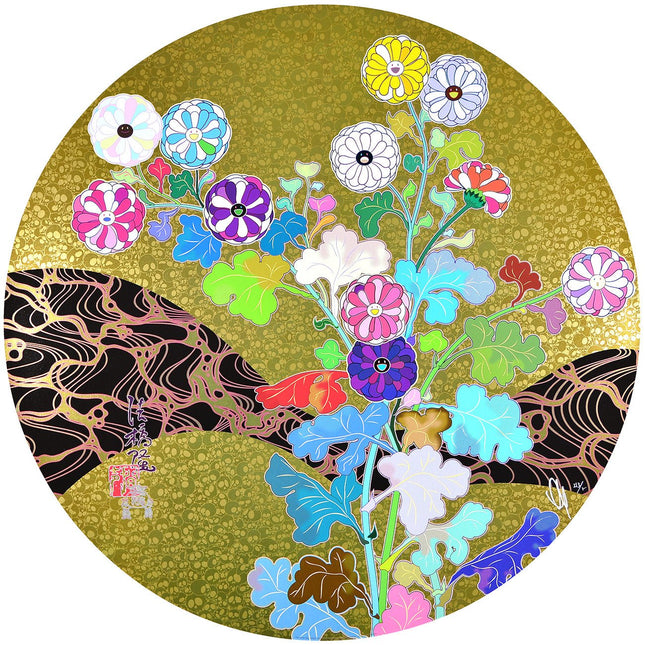
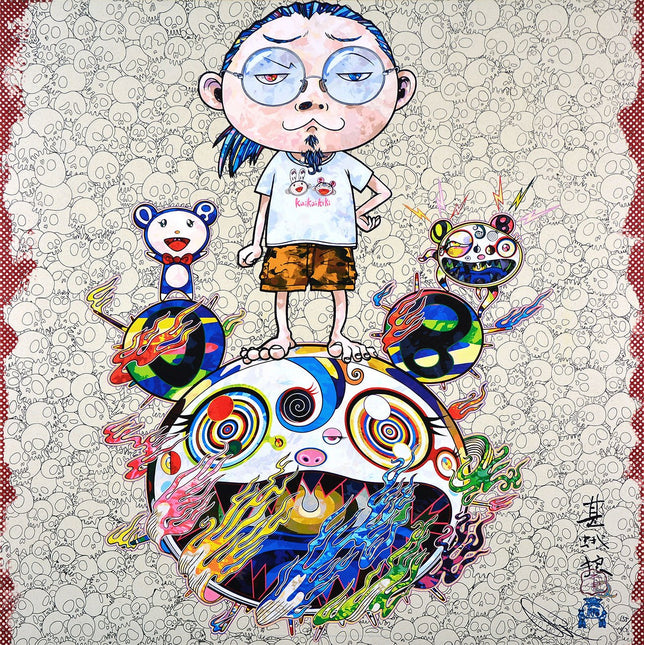
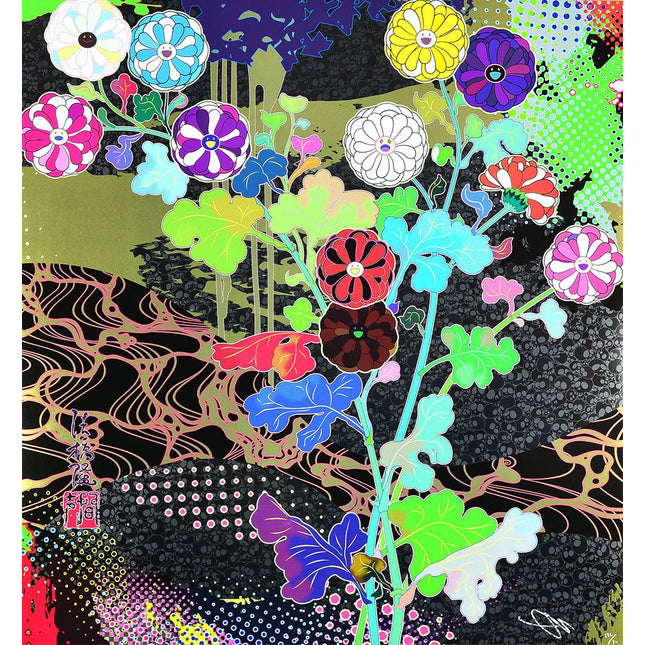
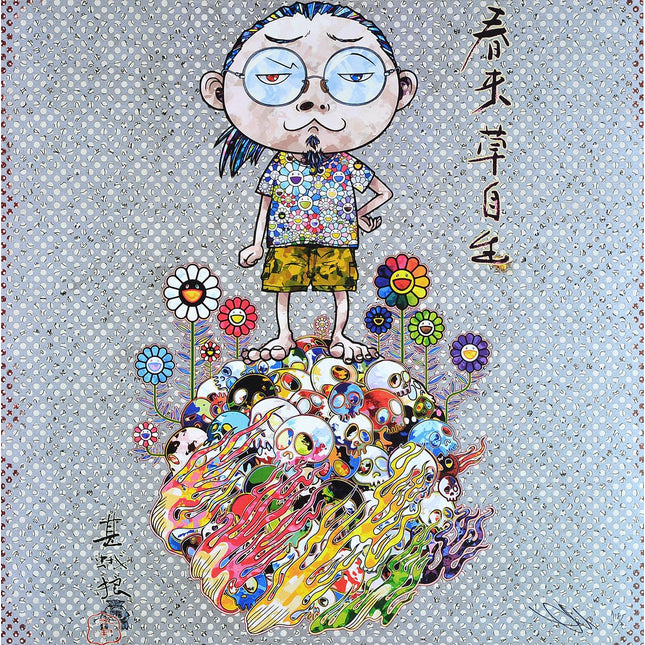
Offset lithograph with cold stamp and UV gloss varnishing on paper, hand signed and numbered by Takashi Murakami. Limited edition of 300, published by Kaikai Kiki Co.
Ensō: Amitabha Buddha is organised around one of the most concentrated and resonant forms in Japanese culture: the circle. In Murakami’s hands, the ensō does not appear as an isolated emblem of Zen purity, but as a living sign placed within a far denser visual field. Rather than stripping the image down, the artist allows the circle to emerge from a background of flowers and skulls, turning it into a point of focus within a world already charged with repetition, ornament and symbolic tension.
In Zen practice, the ensō is often associated with wholeness, clarity, elegance and the state of mind in which creation occurs without hesitation. Because it is traditionally executed in a single gesture, it is also understood as a trace of presence: a form that reveals something of the spirit and concentration of its maker. Murakami preserves that philosophical resonance, but he brings it into contact with a visual vocabulary that is deliberately saturated, ornamental and contemporary. The work does not present contemplation as withdrawal; it suggests, instead, that stillness has to be found from within the noise.
The reference to Amitabha Buddha gives the image an added spiritual depth. It shifts the circle away from being merely formal and opens it toward ideas of compassion, transcendence and inward illumination. At the same time, Murakami refuses any pious solemnity. The ensō floats over a background filled with some of his most recognisable motifs, so that serenity and excess, devotion and visual pleasure, are held in deliberate suspension. That contrast gives the print much of its distinctive force.
What is especially striking here is the way Murakami handles recurrence. Flowers and skulls, so central to his iconography, do not function as a familiar backdrop alone; they create a vibrating field against which the circle becomes newly legible. Seen this way, Ensō: Amitabha Buddha is less about fusion than about calibration: an image in which symbolic concentration is tested against proliferation, and in which the language of contemporary image-making remains open to older spiritual forms. For readers interested in the broader range of Murakami’s themes and symbols, Artetrama also offers further context on Murakami’s visual universe and on collecting contemporary art.
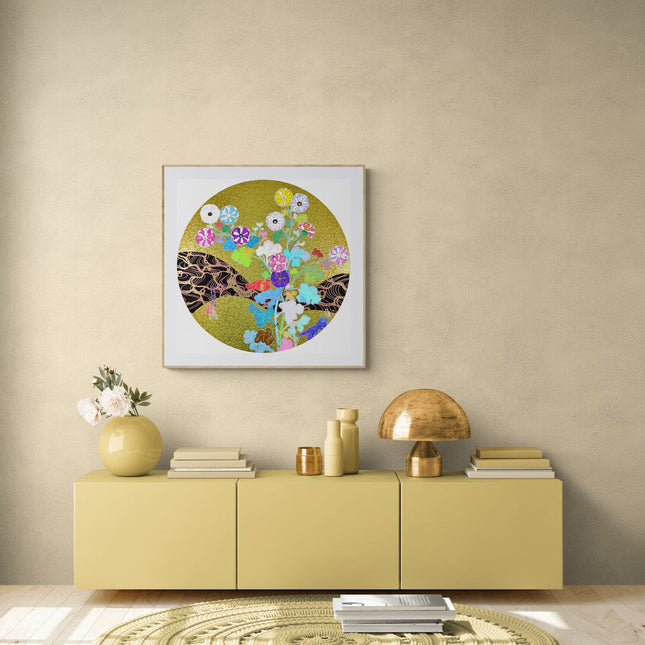
The material construction of the edition is integral to that experience. Offset lithography, cold stamping and UV gloss varnish give the surface a reflective sharpness that changes subtly with the light, heightening the dialogue between meditative form and ornamental density. As a signed and numbered edition, the work also invites attention to questions of rarity, finish and long-term value, particularly for collectors interested in edition numbers and collector value, print care and preservation, and framing and presentation.
Ensō: Amitabha Buddha stands out because it resists the easy opposition between spirituality and spectacle. Instead, Murakami allows both to inhabit the same surface, producing a work that is reflective without becoming austere, and visually seductive without losing symbolic weight. For collectors following the artist’s editioned practice more closely, it also sits meaningfully within the wider field of contemporary pop art and the ongoing appeal of Murakami’s signed graphic works.