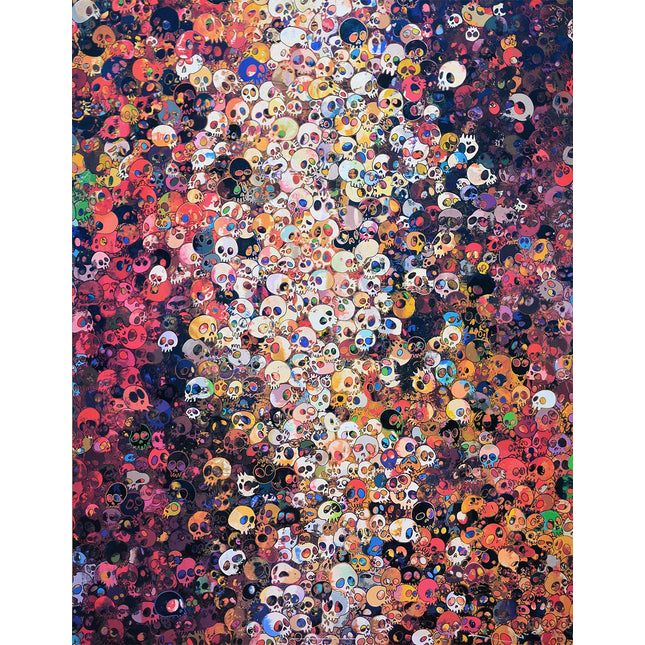
Offset lithograph with cold stamp on paper, hand signed by Takashi Murakami with black pen and numbered from a limited edition of 300. Published by Kaikai Kiki Co. Ltd, Japan.
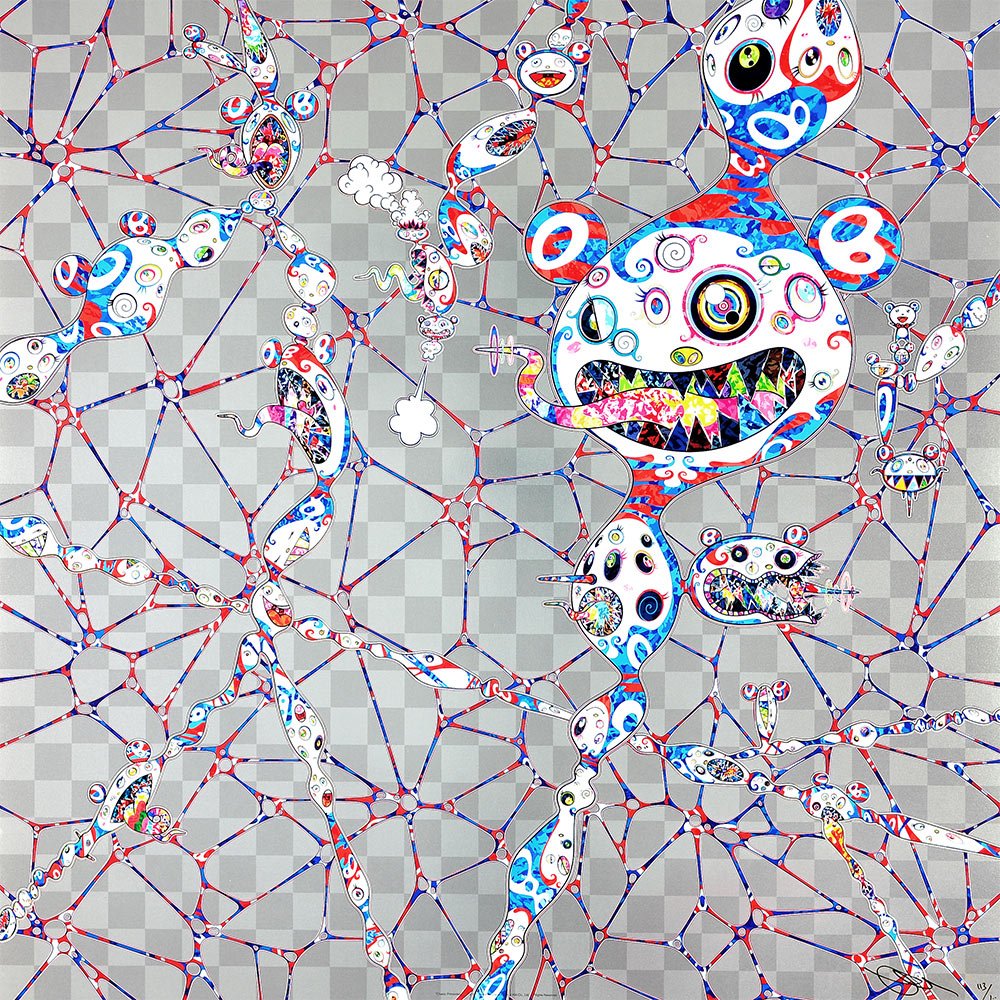
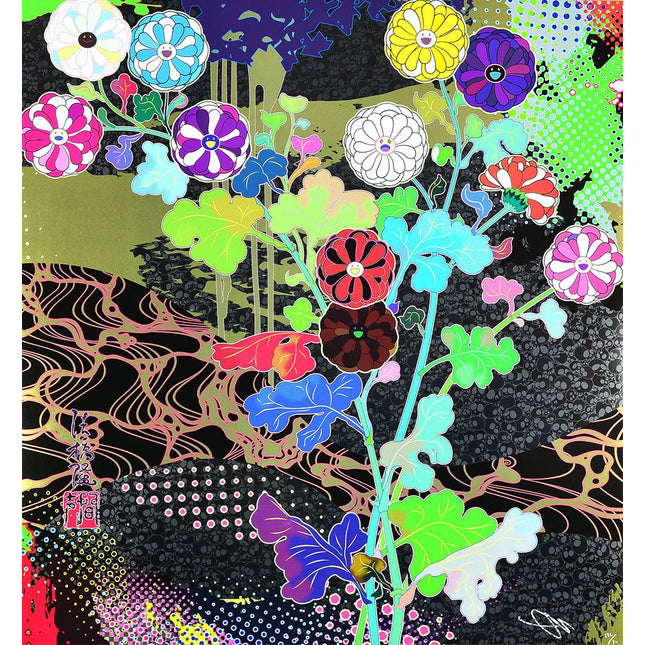
In Chaos: Primordial Life, Murakami moves away from the immediate familiarity of his smiling flowers and turns instead towards a denser, more speculative visual language. The composition appears almost microscopic in scale, as if his iconic DOB figure had dissolved into a field of cellular forms, nervous connections, or primordial particles suspended at the threshold between image and organism.
Set against a muted grey ground, a vibrant network of lines, bursts of red, blue, white, and black, and proliferating forms unfolds across the surface. The image suggests at once neural mapping, organic growth, and abstract diagram, creating a tense equilibrium between structure and visual instability. In this respect, the work opens a compelling chapter within Murakami’s wider symbolic universe, where recurring motifs are often pushed toward increasingly complex and ambiguous states.
The title points to origins: primordial life evokes a moment before fixed form, before any stable distinction between order and disorder. Chaos here is not treated as rupture, but as generative potential, the fertile condition from which all emergence becomes possible. That underlying tension gives the work a more reflective cast and connects it to Murakami’s sustained interest in repetition, mutation, and unstable identity, themes that also resonate with his broader Superflat language.
Created in 2017 as a limited edition of 300, this lithograph is especially engaging for collectors drawn to the more intricate and conceptually layered side of Murakami’s print practice. For a broader view of how technical process can shape meaning in works on paper, contemporary print techniques guide offers useful additional context, while further context on Takashi Murakami’s limited editions provides added insight into the artist’s edition practice.
Chaos: Primordial Life ultimately stands out for the way it balances pop intensity with a quieter, more analytical energy. Rather than delivering a single image to be decoded at once, it unfolds gradually, inviting a slower reading in which abstraction, biology, and imagination remain deliberately entangled.