
Takashi Murakami’s Universe (part 2)
, 6 min reading time
, 6 min reading time
Those that are already familiar with the art of Takashi Murakami may know that Kaikai & Kiki is the name of this artist’s studio. In it, Murakami creates his works and promotes many other artists.
The name of these two characters has a unique origin, the word “kaikaikiki”. This term was used during the late XVI century to describe the works of the Japanese artist Kano Eitoku, of which it was said that his paintings were very powerful but charged with sensibility at the same time.
In the book “Murakami Ego” written by Skira Rizzoli, it can be read about two different meanings for this expression as can be found both in Chinese and Japanese languages. In Japanese “kaikaikiki” is an adjective that describes something disturbing, strange and that can cause fear and uncertainty. However, when “kaikaikiki” is used in Chinese, it is to highlight the bravery, power and extreme sensibility of the subject.
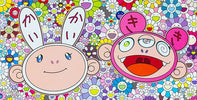
But Kaikai and Kiki are way more than just a brand. These two characters, that are normally shown together, were created almost by chance and are nowadays two of the greatest icons of this Japanese artist.
Kaikai is presumably a kid in a white rabbit costume. Kiki has a pink outfit, three eyes and a couple of fangs. The truth is, if you know how to read Japanese it’s quite clear, as each one has its name written on the ears!

The truth is that the main reason for Takashi Murakami to put these names to the couple of creatures was that it just sounds good. Nevertheless, we understand that there’s a symbolism on them not so casual.
Kaikai and Kiki are normally seen together because they both complement each other. Just like Jekyll and Hyde, yin and yang or the alpha and the omega, these two characters are commonly displayed in a particular manner: Kaikai is located on the left with his mouth shut, while Kiki is on the right side with mouth open.
In Shinto shrines (Shinto is the autochthon religion in Japan) it is quite common to find two lion-dog figures called komainu protecting entrances. These komainu creatures are directly related with the karajishi lions of Chinese origin we can find in front of Buddhist temples and of which we’ve already talked about in our post “Takashi Murakami: The legend of the karajishi”. These komainu always go in pairs and one has its mouth open, referencing the first letter of the Japanese alphabet “ah,” and the other has its mouth shut, pronouncing the last letter “un.” These sounds represent the beginning and the ending of creation, life and death, themes also recurrent in the artist’s works.


Nowadays, Kaikai and Kiki are Takashi Murakami’s own “gods of art” and he pursues a constant search of beauty through them. Kaikai and Kiki, which not always have the religious and cultural connotations mentioned above, acquire different roles that get the audience closer to the artist. Kaikai is sweet and innocent; meanwhile Kiki is wild and naughty. It makes sense to think that these two creatures represent Murakami’s conscience in many of his works. This being said, we should pay special attention to their attitude, disposition and number in every image they are shown. As we can see, once more, Takashi Murakami’s characters have a meaning far beyond what can be appreciated at first glance.
One of Murakami’s most provocative figures, Miss Ko2 first appeared in 1997. With towering legs, exaggerated proportions and a stylized waitress uniform, she satirizes both otaku subculture’s sexual fantasy tropes and Western perceptions of Japanese femininity. Her name—derived from the Japanese word ko (child, young woman or geisha)—also evokes potassium superoxide’s explosive connotation, underscoring her dual role as both alluring icon and cultural critique.
Mr. Pointy merges Buddhist and animist iconography with bright cartoon forms. Sporting a spear-like head and rendered in fiberglass, he evokes traditional shrine guardians and futuristic communication centers alike. Murakami described Mr. Pointy’s spire as a “communication center with outer space,” reflecting the artist’s fascination with technology, history and spiritual transcendence.
Inspired by a 10th-century Buddha sculpture, the Oval Buddha (2007–08) blends classical lotus-pedestal motifs with an anime-style figure. Viewed frontally, Oval appears serene and contemplates enlightenment; from behind, however, his gaping smile reveals a playful, unsettling duality. This quasi-religious character underscores Murakami’s exploration of tradition versus pop culture.
Murakami’s beloved pet dog, Pom, often appears in photographs and painted works as the artist’s most “rooted” character. Unlike his fantastical creations, Pom brings an autobiographical note, reminding viewers of the personal bonds that inform Murakami’s vibrant, larger-than-life universe.
In the animated film and subsequent artworks titled Jellyfish Eyes, Murakami depicts floating jellyfish-like creatures inspired by Japanese folklore’s hyakume. These luminous, semi-transparent beings explore themes of innocence and environmental fragility, adding another layer of emotional resonance to the Superflat aesthetic.
Check out Takashi Murakami’s Universe (part 1) in case you haven’t yet!


