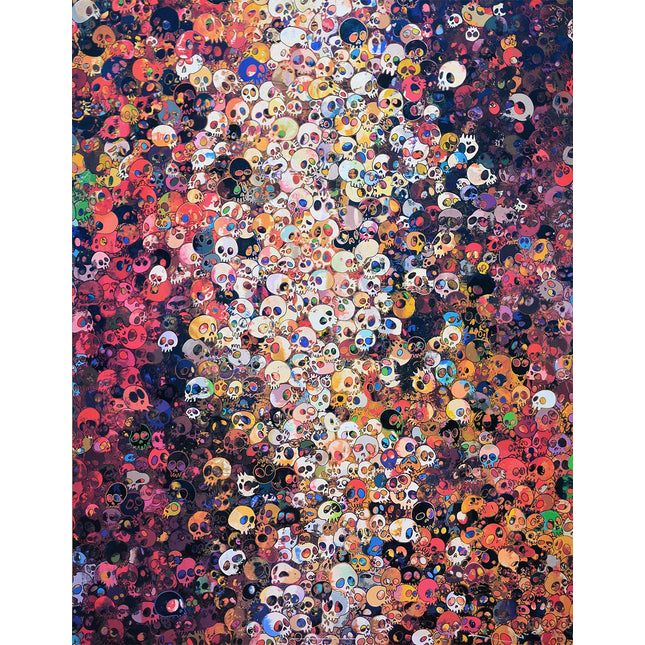
Offset lithograph with cold stamp on paper, hand signed by Takashi Murakami with silver pen and numbered from a limited edition of 300. Published by Kaikai Kiki Co., Japan.
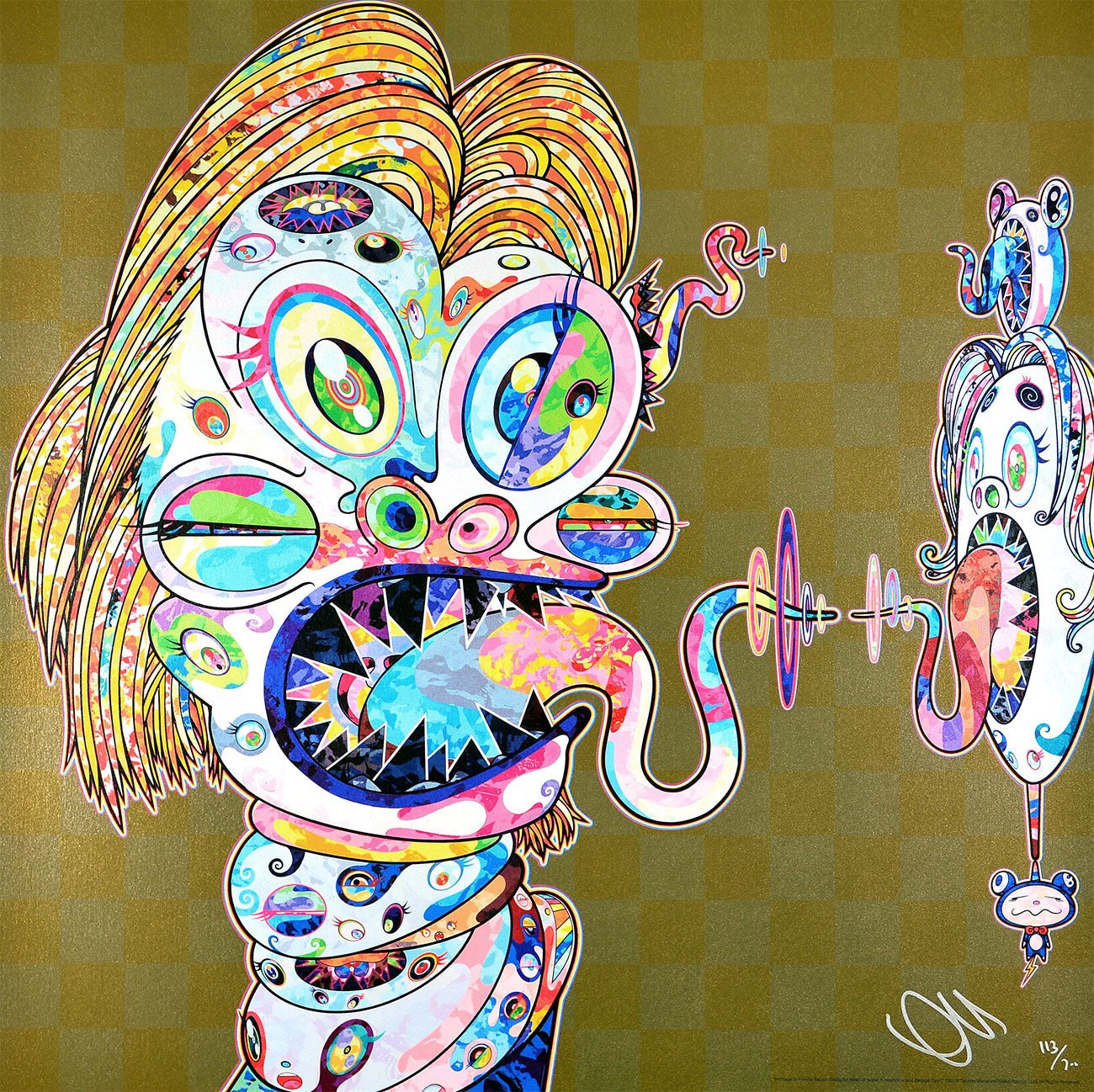
Homage to Francis Bacon: Study for Head of Isabel Rawsthorne is one of those works where Takashi Murakami shows his unique ability to navigate between seemingly opposite worlds, the canon of 20th-century Western art and the hyper-contemporary Japanese pop aesthetic, without ever losing his distinctive voice. Here, the homage is not a simple visual quotation, but a bold and intelligent cultural translation shaped through the language of Japanese Superflat.
Drawing inspiration from Francis Bacon’s portraits of Isabel Rawsthorne, the artist, model, and muse who was a central figure in London’s post-war creative scene, Murakami does not attempt to replicate Bacon’s existential intensity. Instead, he reinterprets it through his own visual language: sharp outlines, vibrant colours, and radical flatness that is anything but superficial.
The distorted face Bacon painted as a manifestation of the human condition in crisis becomes, in Murakami’s hands, a kind of pop mask: grotesque, yes, but also strangely seductive, as if trauma had dressed up in neon costume. Inner violence is transformed into aesthetic explosion; anguish takes the form of a beautiful, disconcerting cartoon that connects naturally with the broader field of contemporary pop art.
The golden background in this edition is no mere embellishment. It is a deliberate choice that lends the piece an almost liturgical dimension. Gold, traditionally reserved for the sacred, here frames the disturbing, the ambiguous, and the emotionally fragmented, as if Murakami were reminding us that the profane, too, deserves its own altar.
Hand signed by the artist and published in a limited edition of 300 by Kaikai Kiki Co. Ltd., this offset lithograph is, like all great contemporary works, a crossroads of time and sensibility: between Bacon’s psychological drama and Murakami’s philosophical playfulness; between portrait as soul-searching and as cultural mask. Readers interested in Murakami’s editions can also explore more about his limited editions and learn more about lithography.
Rather than depicting Isabel Rawsthorne, the work evokes her as a symbol — of beauty, contradiction, and the restless gaze we turn upon ourselves when confronted with the mirror of art.