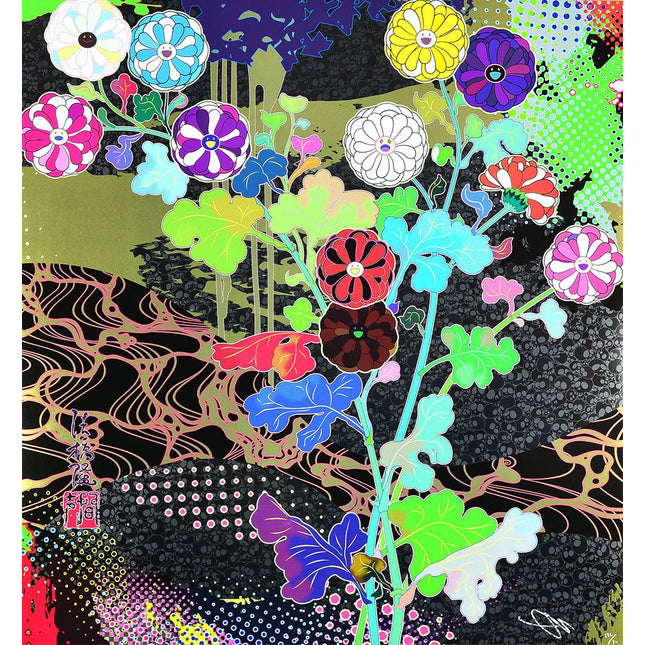
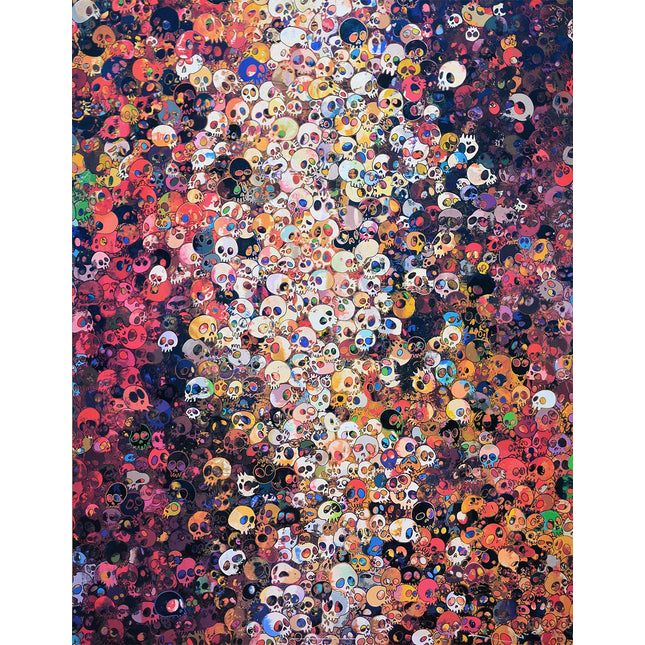
Offset lithograph with silver on paper. This work belongs to a limited edition of 300 and is hand signed and numbered by Takashi Murakami on the lower right corner. Published by Kaikai Kiki Co., Japan.
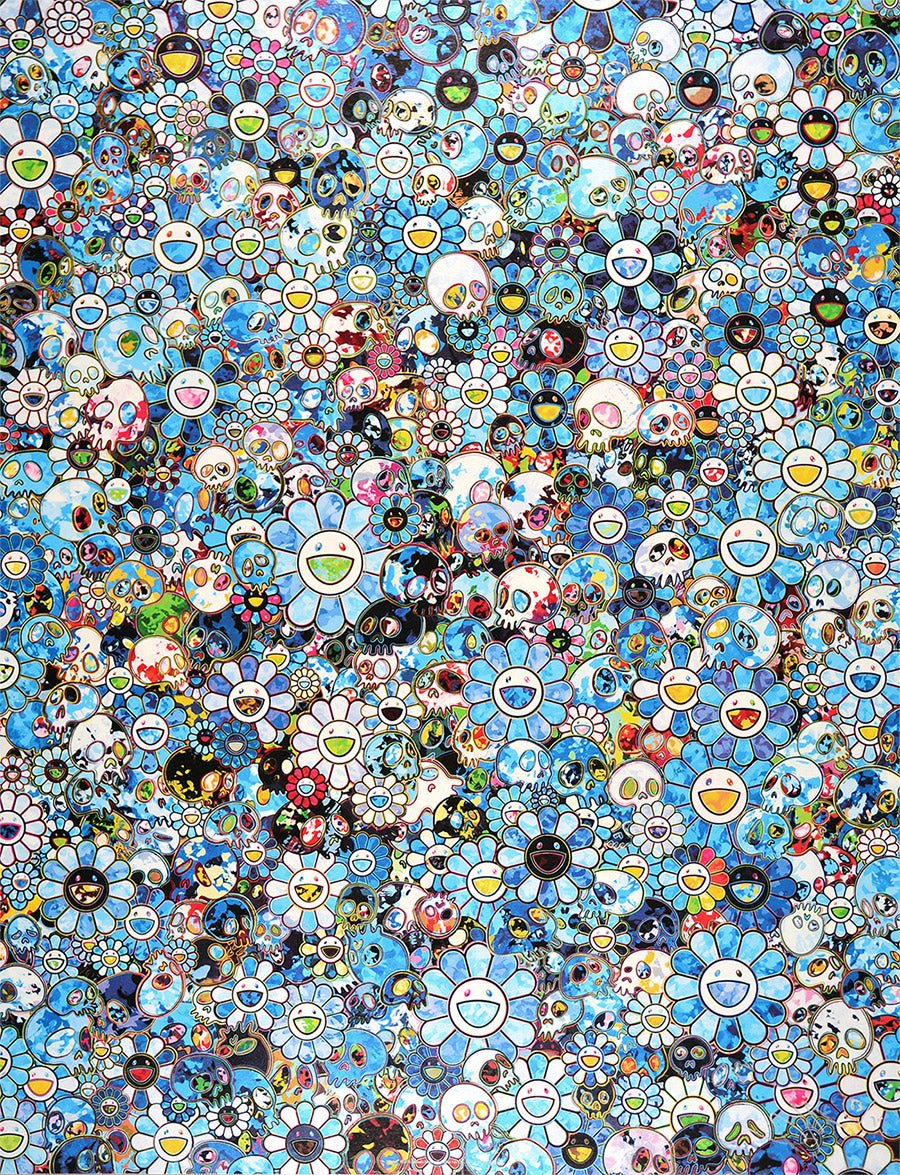
Following the success of Takashi Murakami’s Skulls series and its counterpart, Flowers, the Japanese artist developed a self-referential fusion that both parodies his own imagery and pushes his exploration of dualities further. The result was the Flowers & Skulls series, to which Signal belongs—a body of work in which Murakami intertwines the fleeting beauty of his smiling flowers with the symbolic weight of skulls, long associated with mortality and the passage of time. These compositions evoke both the all-over structures of abstraction and the enduring tradition of vanitas, where floral abundance and skeletal forms coexist as meditations on life’s fragility, a tension that also runs through Murakami’s artistic universe.
In Signal, Murakami creates an immersive composition dominated by his iconic flowers, unfolding in a hypnotic field of deep blue tones. This limited edition print captures the essence of his Superflat philosophy, where chromatic intensity and meticulous repetition generate a visual language that is at once playful and conceptually layered. Here, Murakami’s flowers are not merely decorative motifs but charged symbols of cultural memory, mass production, and the continuous cycle of creation and decay, while the presence of skulls reinforces his sustained engagement with impermanence.
Blue, a recurring motif in Murakami’s work, takes centre stage in Signal, giving the composition a sense of serenity, depth, and open-ended expanse. This chromatic choice can also be placed in dialogue with Murakami’s long-standing interest in Yves Klein, whose radical use of blue as a sign of the infinite and the metaphysical left a lasting mark on contemporary art. In that sense, Signal resonates not only with Murakami’s own flower compositions, but also with wider reflections on colour explored in texts such as IKB in depth and the work of Yves Klein.
The interplay of flowers and skulls within Signal extends Murakami’s long-running meditation on contrast—between exuberant surface and existential depth, between consumer culture and artistic tradition, between the fleeting and the enduring. The rhythmic repetition of the composition suggests movement and expansion, reinforcing the idea of art as an open field of reinvention. For collectors interested in situating the work more broadly, Artetrama also offers further reading on Takashi Murakami’s limited editions, lithography, and collecting contemporary art.