
René Magritte Prints: Editions, authenticity, and how to choose the right piece
, 13 min reading time
, 13 min reading time
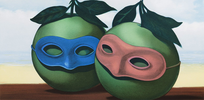
René Magritte didn’t paint what he saw. He painted what might happen if reality woke up one morning and decided to renegotiate the rules. When most people picture Surrealism, they imagine melting clocks and dream logic visions spilling onto canvas. Magritte did something more unsettling: he made the impossible look perfectly reasonable. A man in a bowler hat with an apple politely floating where his face should be. A train emerging from a fireplace as if the living room had always been a station. A stone hovering mid-air with the calm certainty of gravity simply forgetting to show up.
But here’s the important collector’s clarification: many of the best-known Magritte images began as paintings, and later entered the world of fine art prints through different kinds of editions, some created during the artist’s lifetime, others published later under rights-holder supervision. Understanding which kind of edition you’re looking at is the difference between buying a serious limited lithograph and buying a decorative reproduction that only borrows Magritte’s silhouette.
René Magritte (1898–1967) was a Belgian artist who refused the theatrical turbulence many people associate with Surrealism. Where Dalí staged feverish dreams and Miró drifted into abstraction, Magritte did something sharper: he built images that behave like questions. He even described his approach as a kind of painting of ideas. Not "look how I feel", but "look again, what exactly are you looking at?" And once that question lands, it doesn’t politely leave.
Magritte believed art should provoke thought more than emotion. He famously stated: "The act of seeing is the opposite of the act of thinking". It’s a line that sounds simple until you notice how accurately it describes modern life: we see constantly, but we rarely stop to think about what seeing means. Magritte’s paintings don’t beg you to "feel something". They invite you to doubt what you thought was obvious.
Key themes in Magritte's work:
One of Magritte’s great tricks is that he circles a handful of obsessions and makes them endlessly fresh. Identity is the obvious one: who are we beneath the surface, and how much of the "self" is simply presentation (think of the bowler hat, that impeccably respectable disguise)? Language is another: words don’t naturally belong to things, we attach labels like tags on luggage, then act shocked when meaning travels poorly. Reality itself is always under interrogation: is an image an object, or a representation wearing an object’s costume? And transformation hovers over everything, because Magritte understood that the ordinary becomes extraordinary not by changing its appearance, but by changing the rules we assume it must obey.
When collectors say "a Magritte print", they may be referring to very different things. Broadly, Magritte-related works on paper fall into three practical buckets: original prints (made during the artist’s lifetime with the artist’s direct involvement), later licensed/authorized fine art editions (published after the artist’s death under rights-holder supervision), and decorative reproductions (unlimited posters or “giclées” that may look nice but are not fine art editions in the strict sense). Magritte’s market includes all three, and confusion is common, sometimes accidental, sometimes convenient.
The editions emphasized at Artetrama belong to the serious, rights-supervised category: limited lithographs published with formal authorization and verification mechanisms such as stamps, countersignature, and documentation. In other words: not "random Magritte-style posters", but controlled editions built for collectors who care about provenance.
It’s tempting to reduce Magritte to one or two "poster-famous" images. But Magritte’s career is vast, and his real signature is not a single motif, it’s a way of thinking. Across decades, he returned to a set of visual strategies: ordinary objects placed in impossible logic, language treated as a suspect witness, and reality presented with such calm precision that the absurd feels official.
To keep the categories clear: many of the images collectors love first appeared as paintings (often oils), and later entered the world of fine art printing through authorized, limited lithograph editions "after" Magritte. The image may be instantly recognizable, but the edition’s nature, publisher trail, rights supervision, and documentation, is what defines what you are actually collecting.
Magritte is essential to the modern mind because he makes representation misbehave. The classic example is The Treachery of Images, the famous pipe paired with Ceci n’est pas une pipe, a reminder that an image is not a thing, and a word is not a guarantee. Once you understand that move, you start noticing it everywhere: in advertising, politics, social media, and even how we describe ourselves. Magritte didn’t just paint a pipe; he painted the trap we fall into when we mistake symbols for reality.
If The Son of Man is the popular "face" of Magritte, The Empire of Light is the deeper spell: a daylight sky hovering above a nighttime street, as if time itself agreed to split the difference. It’s not a dream scene; it’s a perfectly painted contradiction. Magritte repeatedly returned to this kind of quiet impossibility because it feels like thought made visible.
Magritte also loved the question "Where does the world end and representation begin?" Works like The Human Condition (a painting within a painting that merges with the landscape behind it) make the viewer complicit: you can’t look at it without realizing you are always looking through a mental frame. This theme matters for print collectors, because it mirrors the central question of editions: what is the image, what is the object, and what is the authorized form of that image in the world?
Magritte’s suited men, sometimes multiplied, sometimes masked, sometimes turned into a pattern, are less "characters" than a philosophical device. In Golconda, repetition becomes a kind of pressure: individuality dissolves into sameness, yet every figure still insists on being a person. In The Son of Man, the same respectable silhouette becomes an elegant refusal to be fully known.
These are only a few doors into Magritte’s world, not a complete map. The point is simple: his career is broad, but it is unified by a consistent intelligence, one that makes the familiar feel strange without ever losing composure.
Magritte influenced Conceptual Art, Pop Art, and later debates about representation and meaning. His imagery is institutionally validated and culturally persistent, which is why controlled editions continue to attract serious collector attention.
One of the clearest signals of seriousness in Magritte print collecting is a published framework that explicitly describes limited, numbered editions and the verification mechanisms attached to them. For example, the publisher/printer descriptions for certain Magritte lithograph editions specify limited editions, a traditional lithographic process (one drawing per color, one color per press run), and supervision/validation by rights and authors’ organizations, alongside a countersignature by the representative of the Magritte Succession. These editions are also described as having dry stamps and a proof of edition on the back, plus a certificate of authenticity.
At Artetrama, the Magritte lithographs we offer fit precisely into this supervised-edition model: printed and published in 2004 in the Art-Lithographies studio in Paris on 100% cotton 300 g/m² BFK Rives paper. The artwork is entirely made in France, from the production of the paper in Arches (Vosges) to the traditional lithographic printing process, one drawing for each different color, one color per press run. The lithograph was authorized, supervised and validated by the ADAGP (Society of Authors in the Graphic and Plastic Arts) and by Mr. Charly Herscovici, President of the Magritte Foundation, Chairman of the Magritte Museum and unique representative of the Magritte Succession.
Explore our collection: Magritte Lithographs
Official reproductions can be authorized, but counterfeits and vague "decorative" editions exist. The safest mindset is simple: buy the documentation and the print comes with it.
Start with the edition framework: numbered limitation, identifiable publisher/printer, and a consistent story that matches what serious Magritte editions publicly describe. Then look for verification mechanisms commonly associated with supervised Magritte lithograph editions: dry stamps, countersignature by the Magritte Succession’s representative, and a proof of edition. For a step-by-step guide (with visual cues): Print Authentication & Spotting Fakes.
If a listing relies on vague claims rather than verifiable details, treat it as a red flag. The safest approach is simple: confirm the edition information, publisher details, paper, printing quality, and documentation before you commit.
Magritte doesn’t just "match a sofa". He changes the atmosphere of a room. Placement matters because his images behave like intellectual magnets: they pull attention, then invite conversation, then quietly keep working long after the guests leave.
A library or study is the obvious choice: Magritte above a desk feels like a private reminder that identity is complicated and certainty is optional. A bedroom can work beautifully for The Lovers, because it brings intimacy into contact with mystery, romantic, but not sentimental. Entryways and hallways are excellent for Golconde, which turns a transitional space into a statement and makes visitors pause before they even put their keys down. And living rooms, when kept visually calm, let Magritte become a focal point without competing with furniture or clutter.
Magritte typically shines against neutral walls (white, soft gray, light taupe), with minimal competing décor and simple frames, dark wood or black are often enough. Warm, controlled lighting helps, and eye-level hanging keeps the work conversational rather than decorative. For a more detailed approach: Prints as a Statement in Interior Design.
With Magritte, quality isn’t a luxury, it’s the entire point. If the edition is wrong, the meaning collapses. So buy from places that can explain what they’re selling without improvising.
Authorized galleries and reputable print dealers are still the gold standard because they tend to have documentation, standards, and accountability. Museum shops can also be a safe route for official editions. Online can work too, but only when "curated" means real vetting, clear guarantees, and full edition information, not a nice website and a confident tone.
If there is no certificate of authenticity, no verifiable edition information, and no transparent seller history, that isn’t "a bargain", it’s an invitation to regret. Vague descriptions, evasive answers, and paper that looks thin or glossy in photos are not minor details in prints; they are the plot.
Explore authenticated Magritte lithographs: Magritte Collection at Artetrama
Collecting Magritte is less about owning a "famous image" and more about living with a particular kind of thinking. His work trains the eye to distrust shortcuts: a picture is not a thing, a label is not the truth, and what looks "obvious" is usually just a habit. That’s why Magritte remains contemporary, because modern life is built out of images that constantly pretend to be reality.
Some collectors fall in love with the linguistic sting of The Treachery of Images. Others prefer the atmospheric contradiction of The Empire of Light, where day and night coexist with total confidence. Others are drawn to the perceptual puzzle of The Human Condition, or to the social unease inside Golconda. Even when the motifs change, apples, bowler hats, curtains, skies, windows, stones, Magritte’s central gift stays the same: he turns certainty into a question, and makes that question beautiful enough to hang on a wall.
That is also why authorized, limited lithograph editions are so compelling: they bring these ideas into the everyday without turning them into mere décor. A serious Magritte edition isn’t just an image you like, it’s a long-term companion for looking, thinking, and rethinking.
Start Your Magritte Collection Today Whether this is your first art purchase or your hundredth, Magritte offers something rare: intellectual depth with visual elegance. Discover our curated Magritte collection: Magritte Authenticated Prints or explore Surrealism Collection for Magritte and contemporary Surrealist-inspired artists.


