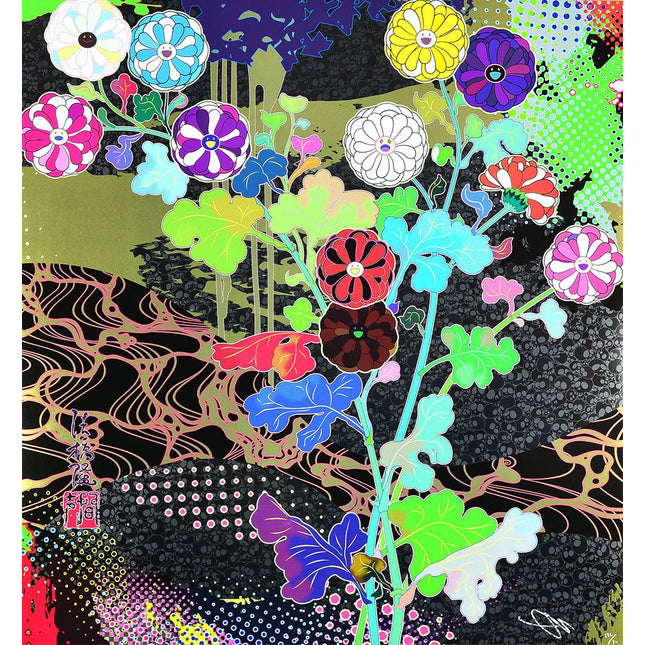
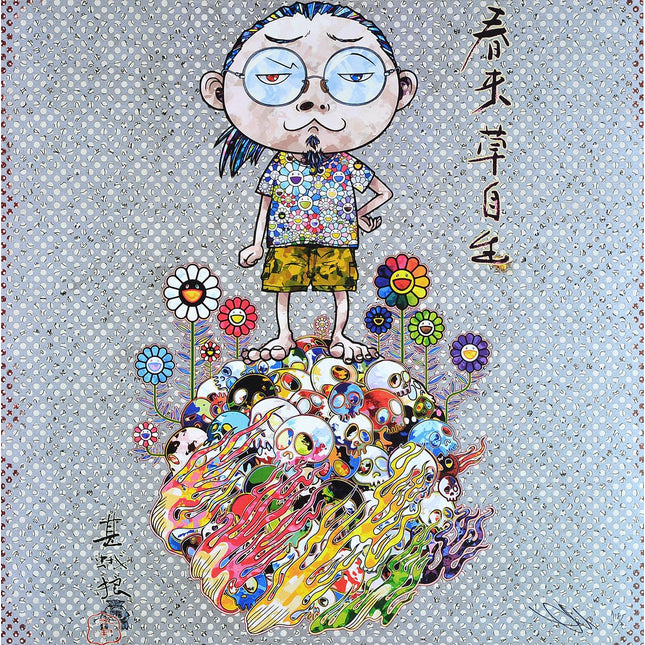
Offset lithograph with silver on paper, hand signed and numbered by Takashi Murakami, from a limited edition of 300. Published by Kaikai Kiki Co. Ltd, Japan.
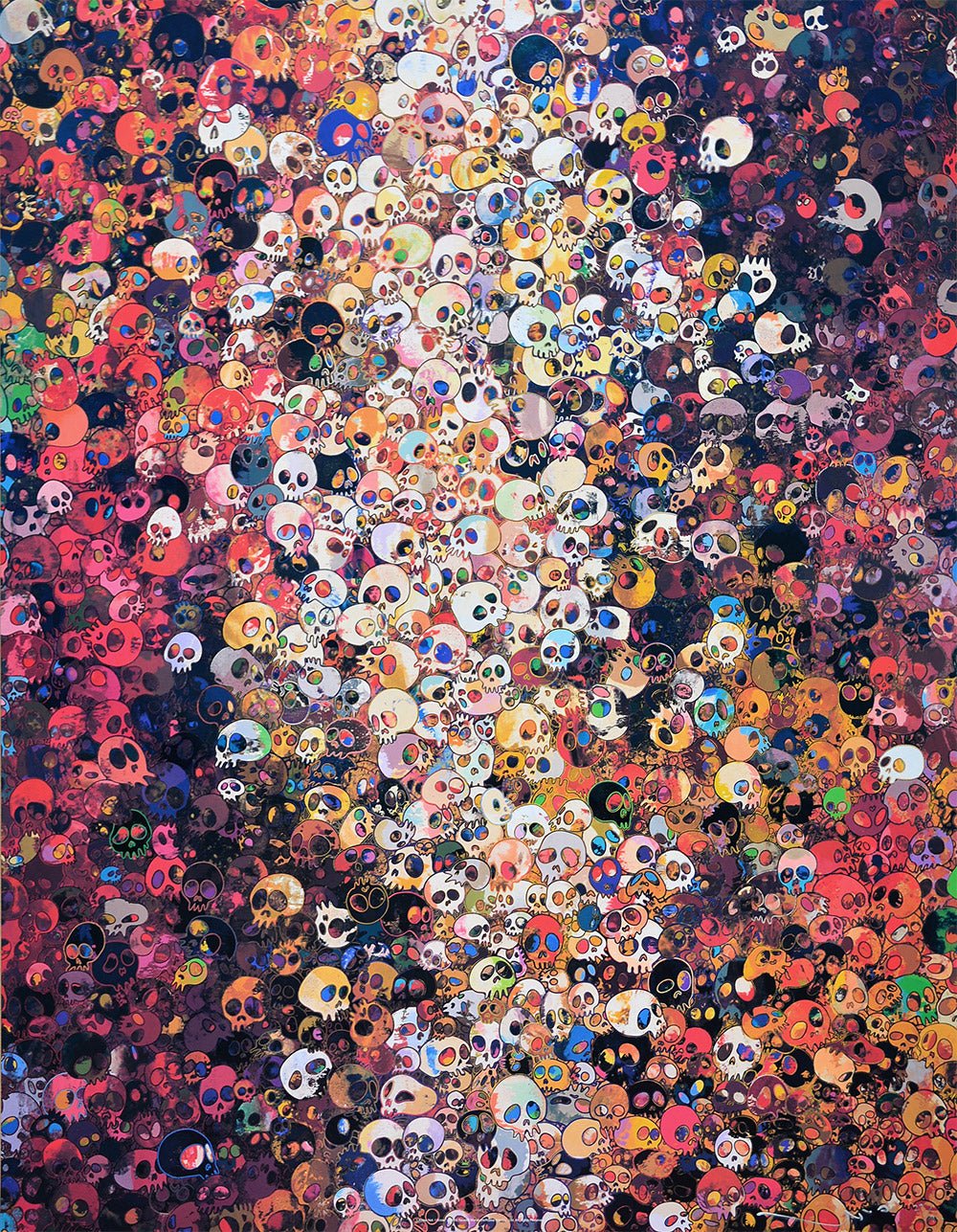
In I Know Not, I Know, Takashi Murakami once again explores one of his recurring motifs: the skull, a universal symbol of mortality, reinterpreted through his distinctive visual language. The composition is especially striking, built around a dense accumulation of skulls that appear to drift in an ethereal space. Arranged in a sinuous central “S” shape formed by white and pale-toned skulls, they stand out against a rich background of pink, crimson, and dark hues, creating a powerful contrast that draws the eye across the image and recalls the layered visual logic of Murakami’s artistic universe.
The palette of I Know Not, I Know rests on a warm and intense chromatic field dominated by reddish and pink tones that suggest both vitality and decay. Electric blues, purples, and neon greens appear as accents, heightening the tension of the composition without overtaking it. This interplay of saturated colour, deep shadow, and luminous reflection gives the image an almost sculptural presence, reinforcing the sense of movement and transformation that runs through the work and connecting it to Murakami’s wider exploration of contemporary pop art.
Murakami’s use of the skull resonates with a long-standing Japanese visual tradition concerned with the transience of life, yet here that symbol is transformed into something vivid, seductive, and almost hypnotic. In his wider treatment of flowers and skulls, the artist has repeatedly staged the tension between life and death, joy and unease, beauty and impermanence. That same duality remains central here, and readers interested in this aspect of his practice may wish to explore more about Takashi Murakami’s limited editions and the evolution of his imagery through his artistic universe.
Through this work, Murakami does not merely revisit vanitas iconography; he translates it into the language of the Superflat movement, where depth collapses and every element exists on the same visual plane. I Know Not, I Know invites the viewer into a drifting cosmos of skulls in which death is no longer a fixed end point, but part of a continuous circulation of energy, pattern, and colour. For collectors interested in technique as well as meaning, Artetrama also offers further reading on lithography and on collecting contemporary art.