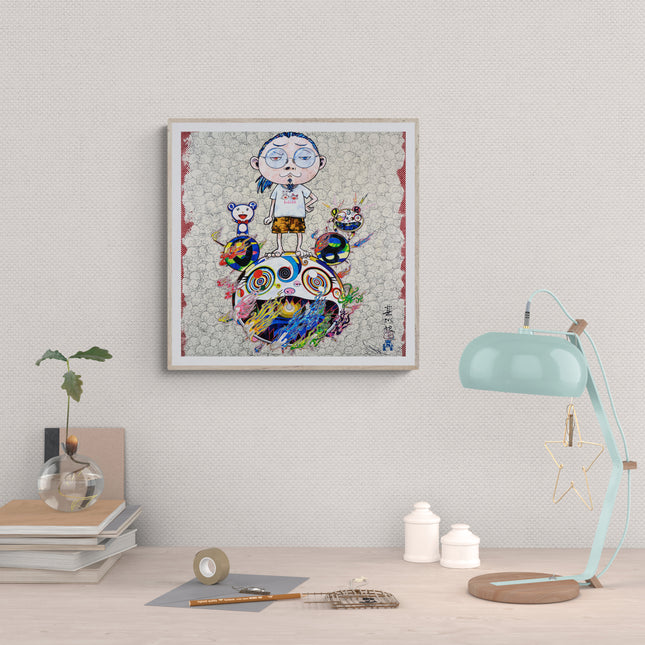
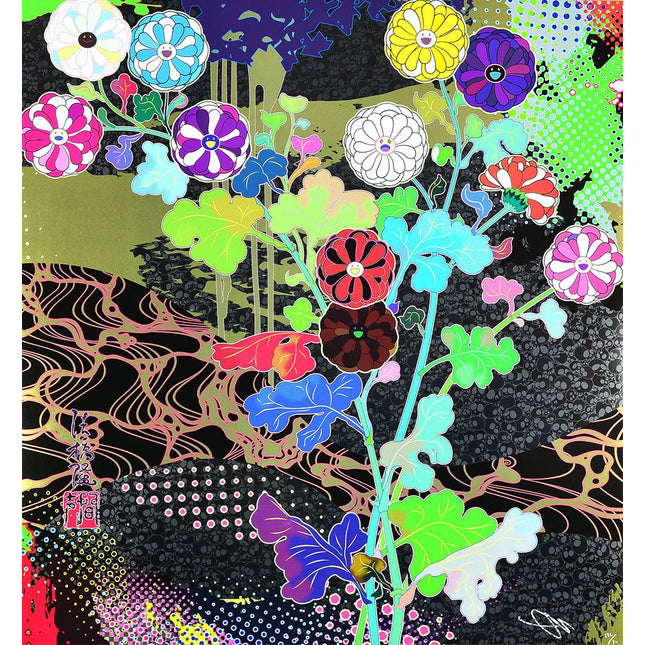
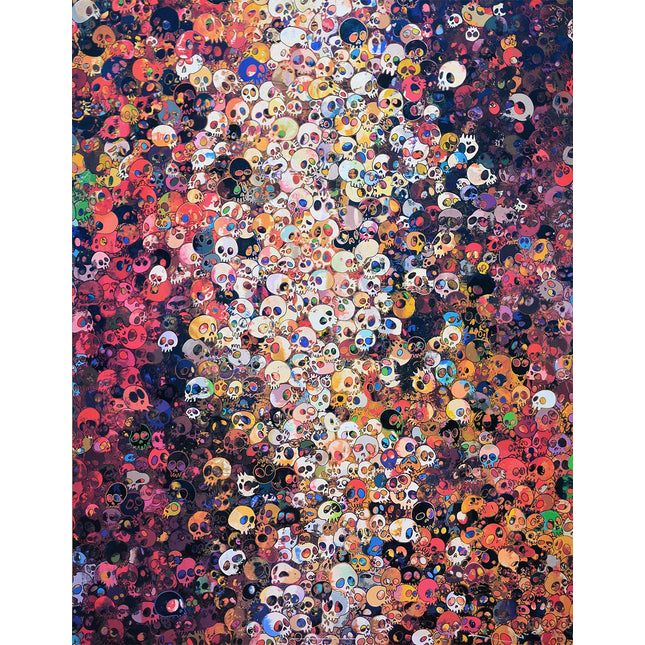
Offset lithograph with silver on paper, hand signed by Takashi Murakami. Numbered edition of 300. Published by Kaikai Kiki Co. Ltd, Japan.
Phantasma is rooted in one of the most extraordinary episodes in Takashi Murakami’s career: the creation of The 500 Arhats, the monumental painting stretching to around 100 metres that became a landmark in his engagement with Buddhist imagery and large-scale narrative form. That vast project did not emerge in isolation. It grew out of Murakami’s sustained conversation with Japanese art history, and especially with earlier depictions of arhats that continue to haunt the cultural imagination behind Murakami’s wider visual world.
What makes that background so compelling is the sheer contrast of scale and temperament between Murakami’s sources. Kano Kazunobu’s celebrated Five Hundred Arhats, created in the late Edo period, unfolds across one hundred hanging scrolls, charged with dramatic characterisation and a forceful pictorial presence. Nagasawa Rosetsu approached the same subject from the opposite extreme, condensing it into a tiny work of roughly 3 centimetres square. Murakami’s own response stands somewhere between homage and transformation, absorbing both the monumental and the improbable into a language unmistakably his own.
Seen in that light, Phantasma is more than an offshoot of a famous series. It carries forward the strange intensity that gives the arhat imagery its lasting power: part spiritual vision, part theatrical invention, part fevered imagination. Murakami does not treat these historical references as fixed relics; he reactivates them, pushing them into a contemporary register shaped by sharp colour, compressed space and an atmosphere that feels at once playful and disquieting. That unstable balance is also central to the logic of the Superflat movement, where historical imagery and contemporary visual culture collide on the same surface.
As a signed and numbered edition, Phantasma also shows how effectively Murakami translates ambitious pictorial ideas into print. The use of offset lithography with silver gives the work a distinct material finish and places it within the broader history of Takashi Murakami’s limited editions, where technical control and visual impact go hand in hand. For collectors interested in the medium as much as the image, Artetrama also offers further reading on lithography, contemporary print techniques and buying fine art prints.