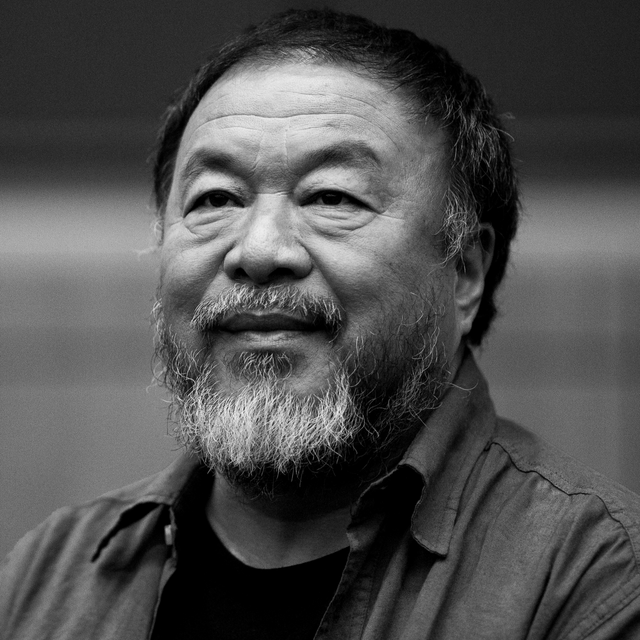
Born in Beijing in 1957, Ai Weiwei is a defining figure in contemporary art and global activism. The son of the renowned modernist poet Ai Qing, he spent his early childhood in a labor camp and subsequent exile in Shihezi, Xinjiang, during the Anti-Rightist Movement purges. This firsthand experience of state authoritarianism fundamentally shaped his later conceptual practice and human rights advocacy.
Following the family's return to Beijing in 1976, Ai studied animation at the Beijing Film Academy and co-founded the avant-garde art group Stars (Xingxing), alongside Ma Desheng and Wang Keping, pioneering Chinese modern art outside government-approved structures. In 1981, he relocated to New York, spending over a decade immersed in the East Village cultural scene. Influenced by Marcel Duchamp’s readymades, Joseph Beuys’ social sculpture, and the mass media critique of Andy Warhol, he developed an analytical approach to object-making and photography that laid the groundwork for his early conceptual output and his subsequent interest in producing highly sought-after limited edition prints.
Ai returned to China in 1993 due to his father’s illness. During this period, he began utilizing historical artifacts to question cultural value and systemic power, famously capturing himself shattering a Han dynasty urn. His critical stance led to iconic series like Study of Perspective, confronting institutional power through a defiant gesture. Despite collaborating with Herzog & de Meuron on the "Bird's Nest" stadium for the 2008 Beijing Olympics, he distanced himself from the project, denouncing it as a political tool.
His systematic documentation of the 2008 Sichuan earthquake casualties triggered severe state retaliation. In 2009, his widely read blog was shut down, and he suffered a severe police beating while attempting to testify for activist Tan Zuoren. This culminated in 2011 with a clandestine 81-day detention, an ordeal he later detailed in his monumental sculpture installation S.A.C.R.E.D. at the 2013 Venice Biennale, an experience that also informed several of his most celebrated numbered editions.
Living and working in Europe since 2015, Ai has expanded his focus to global crises, including displacement and migration. As a pioneer in utilizing digital platforms like Twitter and Instagram as primary mediums for social engagement, his practice rejects purely formal aesthetics. By bridging cultural heritage, ready-made traditions, and political dissent, his work remains an essential pillar for collectors navigating the international contemporary art market.