

Damien Hirst's "Empresses" limited edition in depth
, 15 min reading time
, 15 min reading time
A collector-focused look at Damien Hirst’s The Empresses (H10)—five 100 × 100 cm laminated giclées on aluminium with glitter—honouring Wu Zetian, Nūr Jahān, Theodora, Suiko and Taytu Betul with red/black butterfly mosaics, each signed and numbered on a studio label verso; tips for display, condition checks, and related works inside.
Quick facts: 2022 release; 5 titles; laminated giclée on aluminium composite; glitter screen layer; approx. 100 × 100 cm; hand signed and numbered on studio label (verso); flush mount on metal strainers. Explore Damien Hirst works for sale and individual Empresses below for availability.
Damien Hirst series "Empresses" is an homage to 5 amazing women with a major relevance in history. Little known for western culture, their greatness is celebrated by Hirst. These series of works are created as stunning laminated giclées on aluminium composite panels screen printed with glitter. These works are all hand signed and numbered by Damien Hirst on the label on the back.
Issued in 2022, the set (catalogued as H10) features red and black butterfly wings arranged over blazing crimson grounds, with a glitter screen layer that adds optical “flicker” as you move. Works are typically 100 × 100 cm, laminated to aluminium composite and mounted on metal strainers for clean, flush display; each is signed and numbered on a studio label verso.
Let’s dig a bit more about each one of the works that for this impressive and iconic series by this acclaimed British artist.
The only woman to hold the position of Empress in her own right in China has been Wu Zetian. She was raised in a prosperous family and quickly gained attention for her brilliance and talent. At the age of 14 joined the harem of Emperor Taizong. Immediately following Taizong's death, his son Gaozong assumed the throne and kept Wu in his harem. Given that the concubines were never transferred from father to son, this was somewhat unusual at the period.
Wu replaced Empress Tang after getting rid of her, handling the majority of political choices during her husband's final years. She assumed the roles of widow and regent empress immediately following Gaozong's passing, but she ultimately staged a coup and established her own dynasty.
Empress Wu established herself as an effective ruler for more than ten years, contributing to the growth of the empire's military, education, and infrastructure. In the meantime, her opponents were unwilling to admit that she, a woman, was the one making decisions on imperial China's plans and started spreading rumors about killings, purges, and orgies that gave her a bad reputation.
The truth is that Wu Zetian may be viewed from both perspectives of history, either as a brilliant and capable leader for her country or as a cunning, cruel lady with an evident lust for power.
H10‑1 deploys a hexagonal logic with concentric and radial wing clusters, a subtle nod to the six directions in Chinese cosmology—harmony and completion in glittering red/black regalia.

In a time and place where women were not given any consideration, Nūr Jahān the most powerful woman in 17th-century India, assumed control. Mihr un-Nisa, her birth name, subsequently changed to Nūr Jahān, a name that means "The light of the world," was known for being an adept hunter, a wise ruler, a superb architect, and a delicate poet.
Nūr Jahān didn't have a loyal background, and after becoming a widow, she joined Jahandir, the Mughal Emperor,'s harem. She quickly rose to the status of the Emperor's favorite wife and started to influence political choices.Ner Jahn, the dynasty's sole female king, is highly respected in Bangladeshi, Pakistani, and Indian tradition.
In addition to being an excellent hunter, diplomat, and counselor, Nūr Jahān was a gifted architect who created a tomb for her parents at Agra that served as a model for the Taj Mahal. In fact, her parents' mausoleum is referred to as "the little Taj Mahal" due to its original design. Damien Hirst gives particular emphasis to this architectural aspect of Nūr Jahān and her Agra tomb design in this piece.
Single or paired wings in dramatic red and black tones of different dimensions are grouped into symmetrical patterns in Nūr Jahān. The wings radiate forth from the center in four directions—vertically, horizontally, and diagonally—creating captivating patterns that lead the eye to the center. The surrounding arrangements of wings appear to be retreating, drawing the viewer's attention to the central pair of wings in the focal square composition. This complex, tectonic structure is reminiscent of Nūr Jahān's architectural achievements and the magnificent mosaic tiles that adorn the Agra tomb.
The arrangement of Nūr Jahān is always changing; the more the observers positions themselves in front of it and studies it, the more new passages of patterns of remarkable wings become apparent. This is especially true of the substantial black and red pairs of wings that form an irregular framing around the composition's outer edge. By doing this, Hirst gives this structured composition a sense of life, suggesting that these butterflies are caught in the middle of a range of flight directions.
Architectural energy runs through H10‑2: four-directional vectors and a central “screen” read like Mughal jali in motion, with glitter edging that catches raking light.
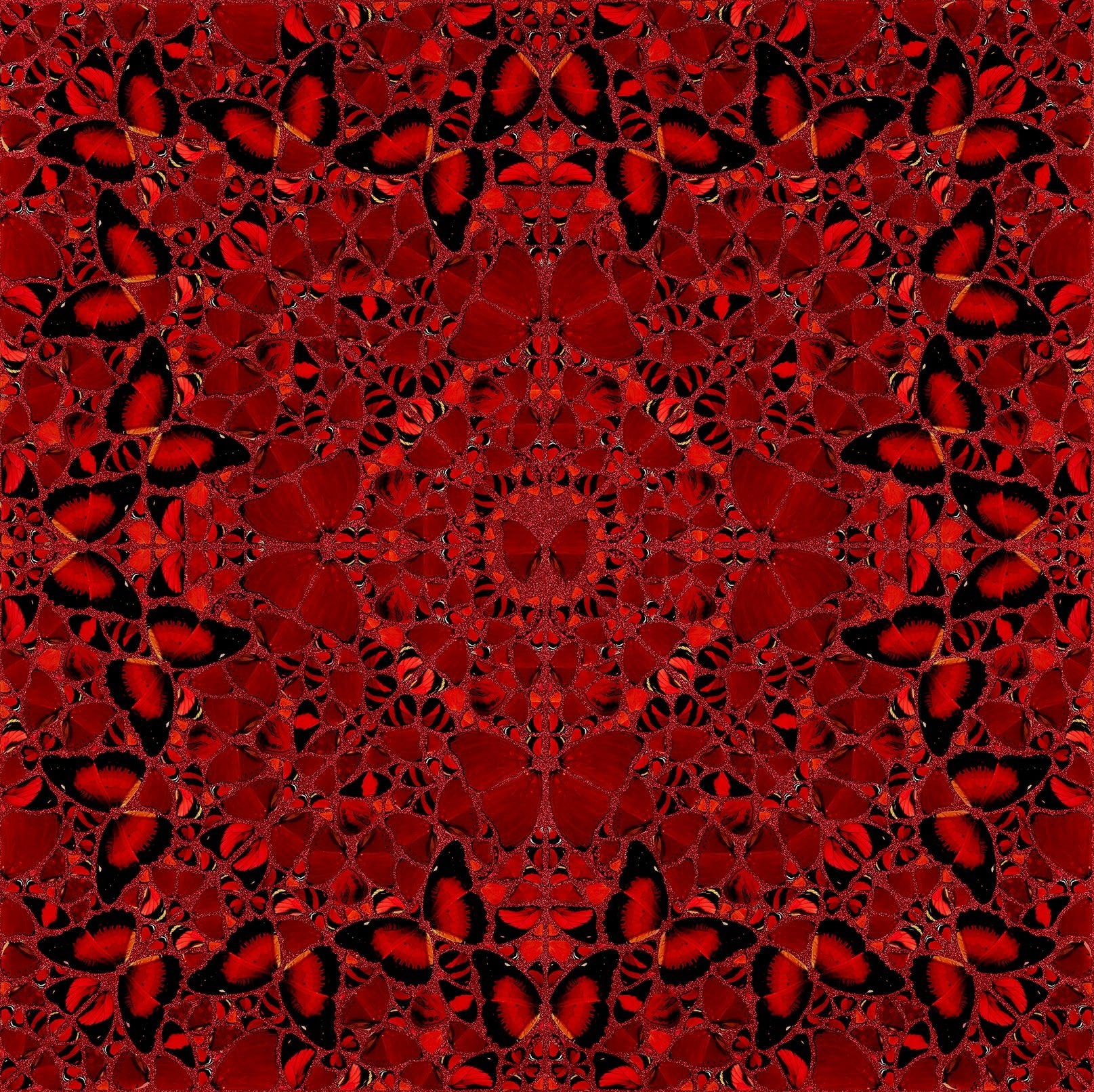
Theodora was Justinian I's wife from 527 until her passing in 548, making her the most significant Empress of the Byzantine era. Despite her modest beginnings, Theodora and her husband are revered as saints in both the Eastern and Oriental Orthodox churches. Theodora was considered to be the formal ruler even though she was not. She was her husband's partner in decision-making and he heeded her smart and dependable counsel in crucial circumstances throughout their reign.
Theodora promoted pro-women policies, such as declaring the trafficking of young girls illegal. Under Theodora's direction, Justinian I issued decrees establishing the death penalty for rape, extending women's rights to property ownership, granting mothers some parental guardianship rights, and outlawing the execution of an adulterous wife. Many people genuinely questioned whether Theodora rather than Justinian was in charge due to her influence over the empire.
Theodora's butterfly wings combine various shades of red and black into a fascinating asymmetrical design that is unique to the series. The print is divided symmetrically into thirds horizontally and halves vertically, with a circle established in the upper half of the print. The composition is defined by lines of dazzling red that are only visible up close. The most noticeable elements are the lower horizontal band, the circle, and the vertical line, which together resemble the feminine gender symbol. Such brings to mind some of Theodora's historic measures that aided women, such as outlawing the trafficking of young girls and changing divorce laws to increase the rights of women.
The degree of structured chaos in Theodora's arrangement of the wings, which appear throughout the piece in pairs or singly, makes it stand out. The skillfully planned asymmetrical composition gives the impression that these wings are alive with movement, zoomed across (and perceptibly beyond) the picture plane and not just dead specimens organized for the viewer's aesthetic enjoyment.
Theodora breaks the set’s stricter symmetries; the circle/band/vertical motif nods to the Venus symbol—an elegant footnote to the Empress’s reforms—kept icon‑flat by the aluminium mount.

Empress Suiko was the first woman to ascend the Chrysanthemum Throne, she reigned for 35 years, from 593 to 628. Only eight women have ever ruled Japan. Suiko was one of the first Buddhist monarchs, and among her many accomplishments are the recognition of Buddhism in Japan, the establishment of diplomatic ties with the court in 600, the adoption of the Twelve Level Cap and Rank System in 603, and the adoption of the Seventeen-Article Constitution in 604.
Damien Hirst's creation has a definite circle-like shape. The butterflies are arranged in a circle with one in the middle. The circle is particularly important when discussing Buddhism and Japan. It is a symbol that characterizes Japanese aesthetics and culture. Depending on the context, it may also be referred to as Dharma or Enso. Some concepts that are directly related to the circle are illumination, elegance, universe, and emptiness.
Suiko's compositional arrangement evokes Buddhist iconography and the life cycle as variously sized paired wings radiate forth from the center of the piece to form a symmetrical concentric circle. Glittering red lines that span the composition diagonally from the center to reach each corner help to define this circular design in an eye-catching way. The lines run through the pairs of bodiless wings, set against a red background, where the bodies previously were.
Suiko is a work in the series that, like the other pieces in it, is constantly changing. As one stands in front of the piece, the butterflies move and change. From a distance, the composition has a fresh life, despite the fact that the print's intricate details can only be fully appreciated up close. Suiko appears to have a ballooning configuration of wings that are arranged around a central pattern of concentric circles and are complemented by outward arrangements of additional wings from this angle. This configuration is reminiscent of a biological or molecular structure, evoking the organisms it represents.
H10‑4 leans into enso logic: the circle calms, the diagonals energize; up close, glitter reads like micro‑tile grout between wings.

Ethiopian noblewoman Taitu Betul served as empress of the Ethiopian Empire (1889–1913) and Emperor Menelik II of Ethiopia's third marriage. Together with her husband Menelik II, who was the ruler of Shewa Province at the time, they established the city of Addis Ababa, which is now the nation's capital, in 1887. She is regarded as a key figure in the history of African women and a pioneer in the struggle against colonialism.
Following a number of marriages, Betul wed the Choa Sahle Myriam monarch in April 1883 who need assistance in the north of the nation. With his position strengthened, Sahle Myriam assumed the title of Menelik II, King of the Kings of Ethiopia, in 1889, and Taytu Betul rose to the position of Empress and became one of her era's most powerful women.
Taytu Betul resisted Italian colonial policies in her nation as a skilled diplomat and fervent nationalist. Any talks that would result in Ethiopian territory being lost were opposed by the Empress. Taytu Betul coordinated the on-the-ground troop supply during the Battle of Adoua in 1896, where the Italians were humiliatingly defeated.
After her husband's passing, she was neglected by Menelik adversaries and the populace. Whether she was powerful or unpopular, Empress Taytu rose to the situation and contributed to building the Ethiopia of today. As a result, her legacy has contributed significantly to Ethiopia's modern history.
Taytu Betul draws attention to the spiral, which is made up of pairs of red and black wings, right away. It starts in the middle of the piece and extends outward, seemingly beyond the picture plane. When Taytu Betul led her army into battle to defend their borders, the momentum that grows as the piece progresses echoes her fervor and physical commitment. These wings are complemented by additional arrangements of wings in different sizes, colors, and patterns that serve as a secondary backdrop to the work's main activity.
Taytu Betul stands out from the rest of the collection for its tenacious effort to capture the butterflies in their authentic, living state. The print's aerial-like design invites viewers to look downward as the composition spirals and develops dynamically, capturing the movement of this group of butterflies.
H10‑5 reads like momentum made visible: a spiral push outward with secondary sorties of wing clusters; glitter highlights behave like tracer lines under angled light.

Each print is a laminated giclée on aluminium composite with a screen‑printed glitter layer; the standard size is 100 × 100 cm with metal strainers on reverse for rigid, flush display, and hand signed and numbered by Hirst on the studio label verso. The red grounds and reflective particles create a “live” optical effect—yes, the wings can feel as if they’re plotting a breakout.
The series launched via a timed release with an option that allowed delayed redemption for the physical print, dynamically setting edition sizes by demand. Secondary markets favor condition, set completeness, and display potential; single icons like Wu Zetian and Suiko often lead on wall appeal.
Check glitter uniformity, lamination edges, and the studio label; request straight‑on and raking‑light photos. Because the works are rigid on aluminium, they hang crisp—pair with high‑CRI LED at 3000–3500K, modest lux. A full Empresses wall needs even spacing and aligned centers; one Empress can command a room with diplomatic immunity.
Browse individual titles—Wu Zetian, Nūr Jahān, Theodora, Suiko, Taytu Betul—or explore the broader Damien Hirst collection for availability, condition reports, and presentation options.
Yes, the series is coherent at approx. 100 × 100 cm, laminated giclée on aluminium composite with a glitter screen layer, each hand signed and numbered on a studio label verso.
Straight‑on and raking‑light photos, close‑ups of glitter/edges, and a clear image of the studio label (signature and numbering) on the back; shipping and packing details if sending internationally.
Sets often command display and curation premiums due to symmetry and narrative cohesion; single highlights also stand strongly alone.


