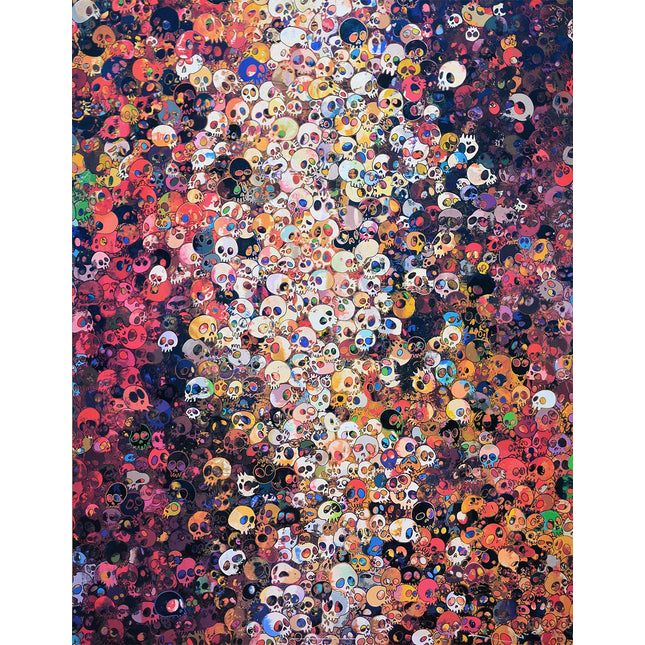
Offset lithograph with silver on paper, hand signed by Takashi Murakami. Numbered edition of 300. Published by Kaikai Kiki Co. Ltd, Japan.
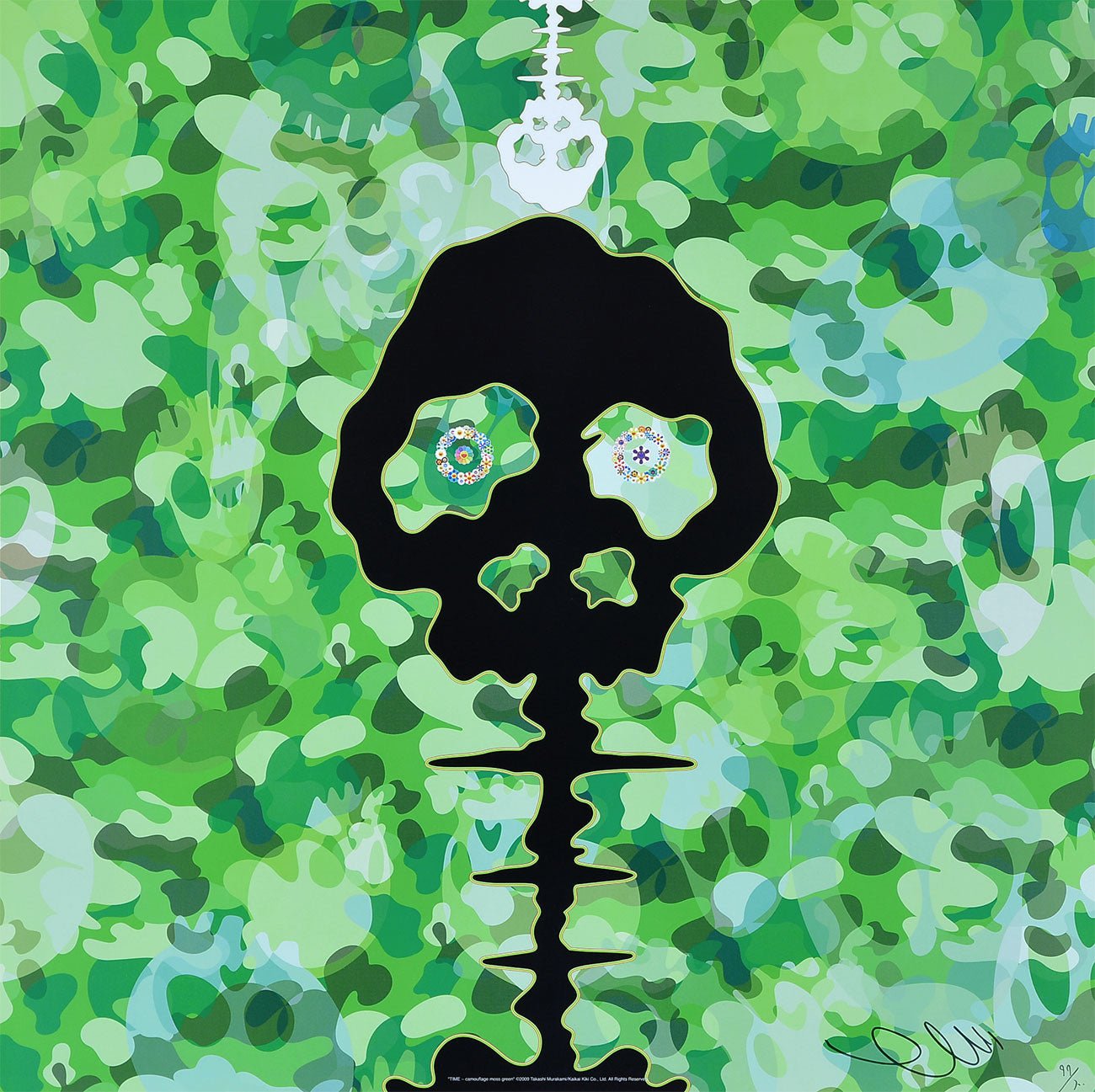
TIME: Camouflage Moss Green belongs to a group of works in which Murakami reactivates one of the most recognisable emblems in his visual universe: the skull. Here, however, the motif is filtered through a camouflage structure that shifts it away from a simple pop image and into a more unstable field of associations, where concealment, repetition, and visual seduction operate at the same time. This layering of beauty and unease is central to Murakami’s artistic universe, in which apparently immediate images often carry deeper cultural and psychological tensions.
The title itself points to the Time Bokan lineage, one of the artist’s long-running references, while the camouflage treatment introduces a different register: one tied to disruption, masking, and coded visibility. In TIME: Camouflage Moss Green, Murakami turns the skull into a repeating sign that feels at once ornamental and disquieting, balancing graphic clarity with conceptual ambiguity. This tension between surface pleasure and underlying instability also speaks directly to the language of the Superflat movement, where depth is compressed but meaning remains layered.
The moss green palette plays an important role in the work’s atmosphere. Less aggressive than brighter chromatic schemes, it gives the composition a restrained, almost military stillness, reinforcing the logic of camouflage while allowing the skull to emerge as both image and interruption. Murakami often uses colour not simply for impact but as a structural device, and here the muted tonal range intensifies the push and pull between visibility and erasure that runs through the composition.
As a limited edition print, the work also reflects Murakami’s sustained engagement with seriality, technical precision, and the circulation of images beyond the singular object. Its use of offset lithography with silver highlights the importance of surface, finish, and controlled repetition within his printed practice, placing it meaningfully within the broader history of Takashi Murakami’s limited editions. For collectors interested in process as well as context, Artetrama also offers further reading on lithography, contemporary print techniques, and buying fine art prints.
TIME: Camouflage Moss Green is a concise but telling example of Murakami’s ability to merge pop immediacy with darker symbolic undercurrents. What first appears as a sharply designed image gradually reveals itself as a meditation on concealment, repetition, mortality, and the unstable relationship between attraction and threat—qualities that also place the work in dialogue with broader currents in contemporary pop art and Japanese postwar image culture.